There should be a motive of this blog. And here, I am trying to give one. The purpose of writing this blog is, at first, to practice my writing, and secondly, to record everyday life experience for future self-examination. So it is either for exhibiting all details of my life, nor for displaying hobby, professional information, although they may be part of the blogposts from time to time. The blogposts is a perceivable record of my rising skill of writing. And posts which are like mirrors for self-analyzing, reflecting the thoughts and gains from my everyday life should have a large share in the blog.
Oct 31, 2004


Oct 30, 2004
my innate rebellion and being a leader

The innate rebellion was controlled within the realm of reality by my long terms of servicing as a leader, best advice one¡¯s parents could give.
the power of example
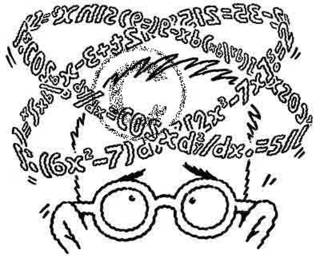
The math textbook in English contains so many examples. I once thought that it is too many. But since these examples are concrete, they help me understand the subject from general abstract definition to concrete vivid things and better the understanding of the abstract terms.
copyright picture from www.cartoonstock.com
Critical thinking

Why is it important to evaluate any information you encounter?
There are also individuals and organizations who, for different reasons, consciously perpetuate lies or partial truths. You simply cannot afford to assume everything you see or hear is accurate and complete.
We should ask questions:
Questioning the information pruducer:
What is the producer's purpose or motive? (Is the information propaganda or an advertisement?)
Is the producer of the information an authority?
Questioning the information itself:
Is the information current?
Is the information complete?
Is there evidence of bias or value-ladened words?
Questioning myself:
Does the information satisfy my needs?
Are there better sources of information elsewhere?
It was not until recently that I discovered how powerful the tool, critical thinking, could be. Its application is not just restricted in evaluation of information as the above paragraph shows. In fact, in daily life when we talk with people, there is a greater need of thinking critically.
Seats

Sitting at the front: listen to speaker more clearly; avoid the disturbance from other audiences.
Sitting in the middle: communicate with other audiences more easily, future profit: making friends more easily.
Qualities of Gentleman

Quality of gentleman
He acts kindly from the impulse of his kind heart.
He respects even the prejudices of men whom he believes are honest.
He opposes without bitterness and yields without admitting defeat.
He is never arrogant, never weak.
He bears himself with dignity, but never haughtily.
Too wise to despise trifles, he is too noble to be mastered by them.
To superiors he is respectful without servility; to equals courteous; to inferiors kind.
He commands with mild authority, and asks favors with grace and assurance.
These are excerpts from the Victorian station. Of the special interest is the second one.
grids and concentric circles

Today two old notions of morality, mentioned by my philosophy teacher, came into my mind when I think about the human love. The notions can be explained as grids and concentric circle of morality. For the first one, it is said that we have some moral principle which guild our actions and we apply it equally to everyone, such as punishing the murder. For the latter, it is said that we owe much more to those near us, so sometimes we tend to tolerant more about them. They sometimes contradict each other in some specific situation. (Actually it is related to my first philosophy paper-when should be ok to play favor to those close to us? May be the one out of only two in my lifetime)
And when I think about desire and impulsion and rationality, I found something similar. If the ration is like the grids and the impulsion is like the concentric circle, I will feel better if I rationalize the degree to which I can extend my desire and impulsion, when I express my feelings and acts accordingly.
Oct 29, 2004
Reading Mill
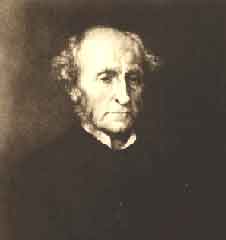
I spent most of my time this week reading J.S. Mill¡'s On Liberty. I thought it was about political science. But then I found that there is many discussions about human nature in general. Some of them are quite deep. I'd like to quote some of them in this post. What's more, one difficulty for me to understand Mill is his 19th century English. It is was not until last a few days of my reading that I found that reading it with reference with a Chinese translated version will make things easier. I have the similar experience when I read science textbooks by myself. To be more specific, since one textbook only offers one version of presenting the subject, we will get better understanding of one subject by referring to several ways of presenting it. We get different approach to it.
Quotations on Mill's On Liberty:
1. Society can and does execute its own mandates: and if it issues wrong mandates instead of right, or any mandates at all in things with which it ought not to meddle, it practices a social tyranny more formidable than many kinds of political oppression, since, though not usually upheld by such extreme penalties, it leaves fewer means of escape, penetrating much more deeply into the details of life, and enslaving the soul itself.
2. No one, indeed, acknowledges to himself that his standard of judgment is his own liking; but an opinion on a point of conduct, not supported by reasons, can only count as one person's preference; and if the reasons, when given, are a mere appeal to a similar preference felt by other people, it is still only many people's liking instead of one.
3. Another grand determining principle of the rules of conduct, both in act and forbearance which have been enforced by law or opinion, has been the servility of mankind towards the supposed preferences or aversions of their temporal masters, or of their gods. This servility though essentially selfish, is not hypocrisy; it gives rise to perfectly genuine sentiments of abhorrence; it made men burn magicians and heretics.
4. That mankind are not infallible; that their truths, for the most part, are only half-truths; that unity of opinion, unless resulting from the fullest and freest comparison of opposite opinions, is not desirable, and diversity not an evil, but a good, until mankind are much more capable than at present of recognizing all sides of the truth, are principles applicable to men's modes of action, not less than to their opinions.
5. But it is the privilege and proper condition of a human being, arrived at the maturity of his faculties, to use and interpret experience in his own way. It is for him to find out what part of recorded experience is properly applicable to his own circumstances and character.
6. He must use observation to see, reasoning and judgment to foresee, activity to gather materials for decision, discrimination to decide, and when he has decided, firmness and self-control to hold to his deliberate decision.
7. Those who have most natural feeling, are always those whose cultivated feelings may be made the strongest. The same strong susceptibilities which make the personal impulses vivid and powerful, are also the source from whence are generated the most passionate love of virtue, and the sternest self-control. It is through the cultivation of these, that society both does its duty and protects its interests: not by rejecting the stuff of which heroes are made, because it knows not how to make them. A person whose desires and impulses are his own-are the expression of his own nature, as it has been developed and modified by his own culture-is said to have a character. One whose desires and impulses are not his own, has no character, no more than a steam-engine has a character.
Oct 26, 2004
Reading newspaper
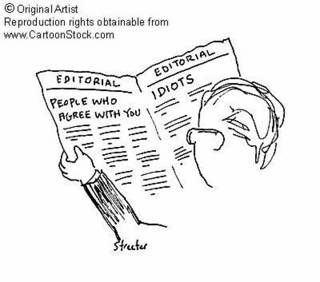
Newspapers are supposed to be in neutral position. But they do not only deal with facts, they present opinions. Sometimes the opinion is hidden between the facts which make it difficult to tell what position they take. We do not read all the newspapers after all. Still more difficult is to identify the value of the society or culture behind the newspaper. To achieve this end, one will not only deal with all the stuff in the newspaper, but also know what important thing is not said in the newspaper.
Every morning, I read The Straight Times, a newspaper widely read in Singapore, and I do not feel anything special about the papers until one day a girl who is in a special education program in NUS, told me some hint. She said that what the Straight Times reports will let you feel that the world is full of danger and uncertainty, but our little island is safe, warm. I think about it, she is probably right. I read from the newspaper that how Chinese government are facing difficulty in steering the economy, how Japan suffers from a recent earthquakes and so on. However, I seldom come across an article that questions the current government and challenge their leaders with hard questions. What I heard is all praise for their great leaders, for how they lead them to the current thrive of S¡ngapore. This is interesting topic of political science. And also recently, an optional reading for my philosophy class is on the political lies, how many kinds of political lies and what function does each achieve. It appears interesting, but unfortunately, I have not done my reading yet. This again relates to something still deeper. It is the values of the society. I look for the definition of values on the web, and find the following stuff on wickipedia. Quite interesting. And I will not be able to write about it today.
Personal and cultural values
Each individual has a set of beliefs and ideas about general concepts that are called values. They describe how much value a person places on various ideas, objects, or beliefs. Societies have values that are shared between many of the participants in that culture.
These values can be grouped into four categories:
Ethics (good, bad, moral, immoral, amoral, right, wrong, permissible, impermissible)
Aesthetics (beautiful, ugly, unbalanced, pleasing)
Doctrine (political, ideological, religious or social beliefs and values)
Inborn (inborn values such as reproduction and survival, a controversial issue)
Oct 25, 2004
Analyzing!!

I recently find a way to analyze one self. Perhaps it is to trivial to others, but I consider it as a great discovery to me.
The way is to separate one self to two part, emotional part and the rational part. The emotional part is what I feel. The rational part is what I think. Most of my daily output including talks, writings and actions, are the results of process of one, or both of the two. For example, appreciating arts is basically purely emotional; forming an argument is basically purely rational. These things will not cause many troubles. What I most concerns is the middle part, which involves both sides and the interaction between them.
The perfect example to illustrate how the two function is about love, particularly the love between young guys and girls of my age. While the emotion part functions predominantly at the beginning of the love, deciding who will get shocked and by whom, the rational part will gradually take the fraction from his counterpart until they two reach a balance. I think the balance varies from people to people, and that¡¯s why there is so many kinds of love. For me, the ration part have a larger share.
Oct 23, 2004
slow in reading

My philosophy teacher says we should not read too fast when reading mill, otherwise we will forget what we have read just a couple of minutes ago. but I think I read too slow. And perhaps, because I read too slow, I do not think much when I was reading. And because I do not think much, I alos do not remember what I read just a couple of minutes ago. It is said that we'd better do the rereading. That works well for me.
change in life goal
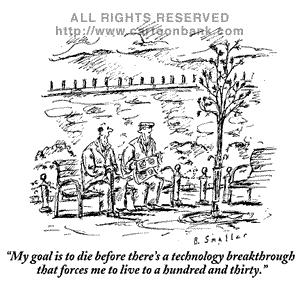
It seems that I have changed my life-goal. In Nanjing univ where natural science research is her major concern, and where I am filled with all kinds of formulas, being a science professor became my life goal. But when I moved away from home, as an exchange student in NUS, the contents of my life has changed a lot. Here, science stuff counts only a small fraction. In NUS, I read Plato, Descartes, Mill; I listen to concert; I realize the power of critical thinking; I join the talk of Entrepreneurship and I write a lot. Not surprisingly, I tend to believe that one's life-goal is not so simple, just to become somthing or someone. I believe, that my life-goal, rather, is to develop the critical thinking, to read more about whatever possible, to gain understanding of human nature and ethics, to appreciate music and arts, and at the things doing science stuff as long as I like doing it.(Perhaps science will be rice bowl.)
I hope when I come back to my home again, I will be able to keep this mindset, and go on to practice whatever I think is good to me.
Oct 21, 2004
what is wisdom
knowledge v.s. wisdom: in the science of music lecture, when the professor try to explain how numbers are transferred in the cable, he said that "every question is a good question, and I am not saying that all physicists and engineers are smart, and all the arts students are dumb." sometimes, we think we are wiser than others because we have more knowledge, but it is not true. wisedom is something beyond knowledge.
Motivated irrationality
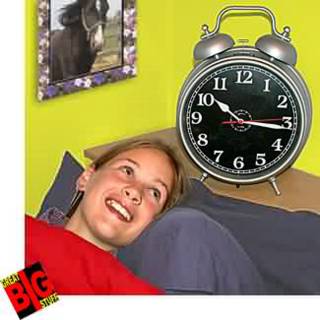
motivated irraionality: the late night Grace want the early morning Grace to get up in the early morning, and she knew that if she put the alarm clock too near her, she will stop the clock and go back to sleep. So, even the late night Grace know that the early morning Grace is going to curse her when getting off the bed, walking across the room to turn down the alarm to be more wake-up, the late night Grace is still going to put the alarm in the opposite end of the room.
or buy one big clock loud enough to wake up the dead.
Oct 18, 2004
the loss of passion

The loss of passion. It seems to me that for all the thing I am going to do, I will at first reason whether it is a good thing to do or not. This is good to me in most cases. However, I therefore, loss the passion of life. It is seems that I should send gifts to my friend, then I send, that I should send a necklace to my girl, then I send. or perhaps, I have not meet the one who can give my real passion yet? perhaps.
Oct 17, 2004
windows XP2

"With the latest update to Microsoft Corp.'s Windows XP operating system, personal computers will soon join parents, bosses, teachers and spouses as a source of nagging in your life. But as Mom always said, it's for your own good."
"You'll get nagged at startup if you're not running an antivirus program or it's out of date. You'll get a warning if a firewall isn't turned on. Other messages pop up when you try to download, install or run software from that sea of malware called the Internet."
well, why I do not see such for-my-own-good nagging on my computer, even though I check my automatic update which is on?
Oct 16, 2004
the Peril of Arrogance

Arrogant person seems to overestimate his/her capacity. I am not an arrogant person, but sometimes over-confident. When I judge other's capacity, I have the tendency, if possible, to compare his/hers to mine. And often, when I thought he/she and I were equally capable of doing certain things, it often turns out that he/she can do better than I do.
Ambition
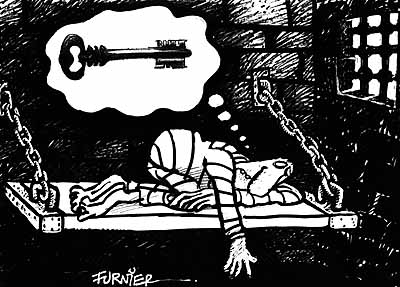
I have just had a talk with a thoughtful and knowledgable girl. She is in a special sholarship program and takes the toughest modules in NUS. She stired up the inner ambition of mine and wake me up from worries about troublesome daily trivials.
copyright picture from http://www.cartoonstock.com/
Oct 15, 2004
imperfect beings and its language, logic
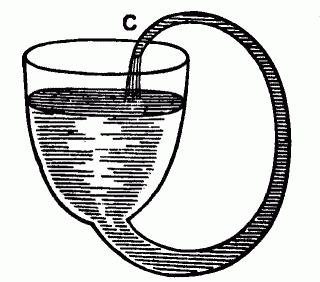
I am working a propability project about the Bertrand's paradox. while those famous mathematicians think it that there may be a hole in the pinciple of indifference. I think this paradox may just be caused purely by imperfection of the human languange and logic. Some E.T.s may do not have such paradoxes at all, perhaps they are now observing us in some remote area in the universe and wondering how these so-called intellectual beings on the planet E!#$h do not try to find flaws in their mind but to work on how to justify the product of their thoughts.


Subscribe to:
Posts (Atom)