Jan 28, 2006

Is Hell exothermic (gives off heat) or endothermic (absorbs heat)?

The following is supposedly an actual question given on a University of Washington chemistry mid-term. The answer by one student was so "profound" that the professor shared it with colleagues, via the Internet, which is, of course, why we now have the pleasure of enjoying it as well.

Bonus Question: Is Hell exothermic (gives off heat) or endothermic (absorbs heat)?

Most of the students wrote proofs of their beliefs using Boyle's law: (gas cools when it expands and heats when it is compressed) or some variant.

One student, however, wrote the following:

First, we need to know how the mass of Hell is changing in time. So, we need to know the rate at which souls are moving into Hell and the rate at which they are leaving. I think that we can safely assume that once a soul gets to Hell, it will not leave. Therefore, no souls are leaving.

As for how many souls are entering Hell, let's look at the different Religions that exist in the world today. Most of these religions state that if you are not a member of their religion, you will go to Hell. Since there is more than one of these religions and since people do not belong to more than one religion, we can project that all souls go to Hell.

With birth and death rates as they are, we can expect the number of souls in Hell to increase exponentially. Now, we look at the rate of change of the volume in Hell because Boyle's Law states that in order for the temperature and pressure in Hell to stay the same, the volume of Hell has to expand proportionately as souls are added. This gives two possibilities:

1. If Hell is expanding at a slower rate than the rate at which souls enter Hell, then the temperature and pressure in Hell will increase until, as the saying goes, all Hell breaks loose.

2. If Hell is expanding at a rate faster than the increase of souls in Hell, then the temperature and pressure will drop until, - - Hell freezes over.

So which is it? If we accept the postulate given to me by Teresa during my Freshman year that, "it will be a cold day in Hell before I sleep with you, and take into account the fact that I slept with her last night, then number 2 must be true, and thus I am sure that Hell is exothermic and has already frozen over. The corollary of this theory is that since Hell has frozen over, it follows that it is not accepting any more souls and is therefore, extinct...leaving only Heaven -- thereby proving the existence of a divine being which explains why, last night, Teresa kept shouting "Oh my God."

THIS STUDENT RECEIVED THE ONLY "A".

Comment on its scientific argument: He assumes that the hell has a positive heat capacity, which means the hell will gives off heat when its temperature drops. But his premises, that every soul goes to hell and no soul leaves it, let me think of black hole, a celestial body which engulfs everything near it. And black hole has a negative heat capacity, which means it will gives out heat when it temperature increases. Therefore, if his premises are all valid, and given that the hell also has a negative heat capacity like black hole, the hell is endothermic.

Comment on its propriety in Chinese culture as a joke: It will inevitably be considered improper as an answer on a mid-term test in major universities in China. But if we consider the attitude of sex portrayed in the movie, American Pie, it might be proper in US.

Jan 22, 2006

My personality profile

Overview
Some of the following information may seem inaccurate or incomplete. Remember, that this profile is a snapshot of your personality at a specific moment. It is not intended as an in-depth analysis of your complete being, but as a tool to aid in self-discovery:

  • You have a strong feeling of optimism, considered favorably by most people around you. Your perception is that the bottle is half-full rather than half-empty.
  • You have a strong sense of humor. You usually know when to lighten a difficult situation, amuse and entertain people.
  • You have to be with people. This extends into the need to gain popularity, achieve social recognition and influence those people around you. The "bottom-line" is a strong people orientation.

Communication
The following statements offer a look at the natural behavior you bring to an interpersonal relationship.

  • You have a natural, outgoing style that some have labeled as the "natural salesperson." You are generally likable, talkative and socially assertive. Your primary intent is convincing or persuading people.
  • You can generate enthusiasm in yourself and in other people. Your enthusiasm, often contagious, involves many people in a social activity who might not ordinarily become involved.
  • You show sympathy to the feelings and needs of others. Your natural empathy style may draw others to you.
  • One of your great strengths is your ability to communicate and talk readily. Since all strengths may be overused at times, you may sometimes talk too much.

Improving communication,
Below is a list of communication styles that will mesh well with your own:

  • Share specific ideas to carry out an action.
  • Be brief, clear and to the point.
  • Motivate and persuade by referring to objectives and RESULTS.
  • Provide options, rather than opinions.
  • Plan sufficient time to talk and listen.
  • Talk about expectations.
  • Support results, not the person, if you agree.
  • Ask for opinions and ideas.
  • Be ready at the exact time.
  • Plan interactions which support dreams and goals.
  • Provide questions and choices for making decisions.
  • Be stimulating, fun-loving, and fast-moving.

Strength
Following are some of the specific strengths and/or personal characteristics that you bring to a relationship. These may form the foundations of many of your friendships and dealings with other people.

  • You are usually enthusiastic about activities and planning.
  • You enjoy situations where you can demonstrate your skill or mastery of a subject.
  • You are optimistic and tend to make others feel good about themselves.
  • You generally don't like to back away from a challenge.
  • You like to analyze problems and discuss their possible solutions before taking action.
  • You are socially poised and people-oriented.
  • You have an excellent sense of humor and tend to see humor in events spontaneously.
  • You tend to enjoy life and share that enjoyment with others.
  • You tend to be influential in decision-making situations. Others often turn to you for advice.
  • You like to initiate new activities.

Needs
While answering the Relationship Questionnaire you established a pattern of basic, subconscious wants. This section of the report was produced by analyzing those patterns. Our wants change as we mature and obtain our life goals. You may find it valuable to revisit this section periodically to see how your wants have changed. You may want:

  • Support of your ideas and dreams.
  • Equal relations with others.
  • Others to adhere to your high standards.
  • Popularity.
  • Acceptance in a variety of groups.
  • Time to adjust to change.
  • Recognition of skills and ability.
  • Social recognition of your accomplishments.
  • A support system to help you get things done.
  • Reassurance.
  • A friendly, favorable social environment.
  • Better planning for change in the future.

I did this personality test in eharmony, an professional online dating service site. I am surprised by my patience to complete such a long questionnaire.

Dec 1, 2005

FACES Beijing: English Sayings

No hurt, no foul.
Red sky at night, sailors' delight; red sky in the morning, sailors take warning.
Beer before liquor, never be sicker; liquor before beer, and clear.

I did a little research on the last saying. It's intersting to see there are so many versions of it.

Beer before liquor, never sicker, liquor before beer, in the clear.
Beer before liquor, get drunk quicker, liquor before beer, shed a tear.
Liquor before beer, in the clear, beer before liquor, even sicker.
Beer before liquor, never sicker, liquor before beer, have no fear.
Beer before Wine, makes you feel fine, Wine before Beer, makes you feel queer.

Here is a tip from Wikihow: how to prevent hangover.
While you shouldn't mix types of alcohol, if you do, always drink the hardest type at the start of the night, and the weakest at the end. Remember this rhyme to help: "Beer before liquor, never been sicker. Liquor before beer, you're in the clear."

Nov 30, 2005

FACES beijing: competitors and collaborators

FACES is about China-US relations. It is the underlying center topic in all seminars, speeches and talks. And even though I do not fully understand about the details (sometimes a single word) of any topic, I identify one common assumption in all the events. And this finding not only reshapes my view of China-US relations, but also the human relations in general.

Before FACES, I generally agreed with the statement that every nation cares about their own interest. And because of the limited space and resources, all nations are ultimately competitors. But in Trade Session, almost every speaker talks about the interdependence of China and US in economy; in Diplomacy Session, almost every speaker talks about the cooperation between China-US in solving regional and global crises; in Research Session, almost every speaker talks about the collaborations between China-US in scientific researches on space, life science and materials. All of these bring out the final underlying assumption: nations have common interests. The common interests will not become clear if one only see problems from the perspective of one country. But they might become obvious when one view problems in a GLOBAL perspective. 'Global' is not a big hollow word. It means that one nation consumes products and services of other nations; it means that the bankrupt of one nation's economy will affect other nations'; it means that the pollution of one nation will affect other nations as well; it also means that the unrest of one nation will make many nations unsafe. The interdependence among nations calls for the collaboration. Therefore, though they might be ultimately competitors, they will also be collaborators all along the way.

If we also see a person as an entity of interests, it is easy to extend this argument of nations to personal level through an analogy (though might be a false analogy). Nations have interests and common interests; so do individuals. If one only sees things from his own perspective, he tends to compete against every one and easily become narrow-minded. Seeing things from other's perspective and identify the common interests are the equivalent of the GLOBAL view in personal level.

Nov 29, 2005

FACES beijing: Ronnie Chen

During the FACES Beijing conference this November, Ronnie Chan, a successful business man (in terms of money), gave a speech on "Americanism vs. Chineseness: Differences and Similarities and How They Affect US-China Relations Today". His speech covers a huge range of topics, such as how Chinese and English language affect people's thinking pattern, medicine, and literature. He talks about why an ABC girl fails in business bidding in China because of her aggressiveness and assertiveness, which are very common in people doing business in US. He talks about why the leadership in China is described as "benevolent dictatorship". He also talks about the corruption in China. In a word, in his speech, I was totally astonished at his amount of knowledge and experience.

The confrontation arises when American delegates question about his classification of Japanese people as amoral people in the Q&A section. In his speech, Ronnie Chen classifies Chinese and American as moral people, and Japanese people as amoral. The base for his argument is that the Japanese deny their outrageous crime in World War 2. Chen questions that what you are going to with a person who just killed 40 people yesterday and ask who they are today. At that moment, I liked his statement very much. But I changed my mind abruptly soon when some delegates argue later that every nation did silly things in the past. Chinese and American both did. So why did Chen use a double standards. And I was ashamed that I did not discover this obvious fallacy in Chen's argument.

Though I do not remember clearly how this argument ends, I learn one thing from it. It's hard for me to keep rational when intense emotion is aroused. Under intense emotion, I am more likely to fail to identify what is opinion and what is fact, what are reasonable and what are irrational. Being completely rational is impossible, but identifying beforehand what my "hot spots" in emotion are will make easy coping with situations like that.

Oct 28, 2005

Quotes about "winning is not everything"

Playing ball is just like life. Winning is not everything. When you face the challenge, you need to have the courage to stand up and shout out: It's my turn! I'll play.

"Winning is not everything, it is the only thing!"Green Bay Packer coach Vincent Limbardi.

Winning is not everything, but the effort to win is.

Oct 27, 2005

For GRE

I took the GRE test last Saturday. I feel that I should write something about it, after all, it's an important test and also a tough one.

Here comes the post about the beautiful sentences with GRE words.

“I just look up at the stars and let the vastness of that black and twinkling canopy fill my soul”(Margaret Mason)

“the smug look of a toad breakfasting on fat marsh flies”(William Pearson)

“Culture is then properly described not as having its origin in curiosity, but as having its origin in the love of perfection” (Matthew Arnold). (culture: denote a personal quality resulting from the development of intellect, manners, and aesthetic appreciation. )

“an ambitious, disingenuous, philistine, and hypocritical operator, who . . . exemplified . . . the most disagreeable traits of his time”(David Cannadine)

“Obedience,/Bane of all genius, virtue, freedom, truth,/Makes slaves of men”(Percy Bysshe Shelley)

“Your true lover of literature is never fastidious” (Robert Southey).

“the weapon which most readily conquers reason: terror and violence” (Adolf Hitler).

“Fear is the parent of cruelty” (J.A. Froude)

“We should not pretend to understand the world only by the intellect; we apprehend it just as much by feeling” (Carl Jung).

“On a summer night . . . a mantle of dust hangs over the gravel roads”(John Dollard)

“He meandered to and fro . . . observing the manners and customs of Hillport society” (Arnold Bennett).

Their infatuation blinded them to the fundamental differences in their points of view.

“The natural bent of my mind was to science”(Thomas Paine)

“Commonly, though not always, we exhort to good actions, we instigate to ill” (Samuel Johnson). (we are exhorted to good actions. Use passive voice?)

“No one could soar into a more intricate labyrinth of refined phraseology” (Anthony Trollope).

“I know and feel what an irksome task the writing of long letters is” (Edmund Burke).

“Russia's final hour, it seemed, approached with inexorable certainty” (W. Bruce Lincoln).

“Most Ivy League freshman classes are chosen from a motley collection of constituencies . . . and a bare majority of entering students can honestly be called scholars”(New York Times)

He stared down at his dinner plate in a morose and unsociable manner.

made a fetish of punctuality

“Every great hostelry flaunted the flag of some foreign potentate” (John Dos Passos)

“Hide me from Day's garish eye”(John Milton)

“Sometimes goldfinches one by one will drop/From low-hung branches . . . /Then off at once, as in a wanton freak” (John Keats).

“For nimble thought can jump both sea and land” (Shakespeare).

At the time, I was too obtuse to grasp the true implications of her behavior.

“Over grass bleached colorless by strong outback sun, the herd oozes forward”(Geraldine Brooks)

“opaque, elusive, minimal meanings”(John Simon)

He stared down at his dinner plate in a morose and unsociable manner.

a morass of detail

“That night he dreamed he was traveling in a foreign country, only it seemed to be a medley of all the countries he'd ever been to and even some he hadn't”(Anne Tyler)

“He is pretty well advanced in years, but hale, robust, and florid” (Tobias Smollett)

“There was nothing feverish or hectic about his vigor”(Erik Erikson)

the young Mozart's prodigious talents

“Miracles are propitious accidents, the natural causes of which are too complicated to be readily understood” (George Santayana).

“Every man had his own quirks and twists” (Harriet Beecher Stowe)

“Keen, poignant agonies seemed to shoot from his neck downward”(Ambrose Bierce)

"Poignant grief cannot endure forever" (W.H. Hudson).

Practice [Example] is better than precept.

“Werner finds himself suddenly in a most awkward predicament” (Thomas Carlyle)

Even a written apology failed to placate the indignant hostess.

ponderous prehistoric beasts

“It would be preposterous to take so grave a step on the advice of an enemy” (J.A. Froude)

the mire of poverty

“The path was altogether indiscernible in the murky darkness which surrounded them” (Sir Walter Scott).

“the narrow crevice of one good deed in a murky life of guilt” (Charles Dickens).

The freighter moored alongside the wharf.

“No idea is so antiquated that it was not once modern. No idea is so modern that it will not someday be antiquated” (Ellen Glasgow).

Sep 24, 2005

isn't it?

Time is limited, isn't it?

Work is rotated, isn't it?

Future is dynamic, isn't it?

Life is fantastic, isn't it?

Aug 26, 2005

Choice

Oracle: I told you before. No one can see beyond a choice they don't understand, and I mean no one.
--Matrix, Revolution

Though the choice seems obvious for me, I experienced a certain extent of confusion when facing big decision in life: to work or to pursue a higher degree. The underlying question of this choice seems to be what I am going to do in the future, what my life goal is, because this decision will undoubtedly affect my life in future. However, I found that my decision is based mostly, not on the vision of the future, which is inherently vague and indefinite for me, but on what I have done in the past. Since every graduate or professional program asks the candidates what preparation of knowledge and skill they have in that specific area, it also seems to be practical and reasonable to do things as if we are laying the bricks, one based another, never awry. But isn't it a bit monotonous?

Where is the change? Where is the turn? Where is the jump? But before answering those questions, answer these questions first: what to change? Where to turn? Where to jump? Ironically, I am back on the original point of the old-friend-like question, which is asked again and again since primary school: what do I want to do? What I have done and what I will do seem to like the questions of which is the first: egg or chicken? The truth, I think, may be that one will never make a decision with absolutely full confidence of its consequences.

Everyone travels with a certain degree of confusion of the destiny. And so do I.

Aug 16, 2005

one friend's signature

One should never increase, beyond what is necessary, the number of entities required to explain anything.

It's an interesting sentence provoking philosophical thought. Before analyzing this claim, I would like to limit "anything" to "things met in ordinary daily life", which exludes any scientific, political or social issues. Things like that will spoil the pure philosophical query here

Understandably, everyone need "some entities" to explain the world and himself or herself if one remain conscious. It's also a great thing that everything is able to be explained by a handful of "entities", and guide the action accordingly when one faces complicated siuations. Imagine that there are principles of life that guide the life just as there are three Newton's laws of mechanism that predict the motion an object. Isn't it a great triumph of human intellect?

It might grow to be an infinite list, but several most important entities that used to explain the motivation of human action includes: (from How to Win Friends and Influence People)

  1. Health and preservation of life.
  2. Food
  3. Sleep
  4. Money and the things money will buy
  5. Life in the hereafter
  6. Sexual gratification
  7. The well-being of our children
  8. The feeling of importance

If one does not want to be exhaustive about his/her list, the above mentioned entities are well-enough in explaining every day's action. One can experience limited situation compared with the sum of all human beings'. Therefore, one does not necessarily to be exhaustive in making his/her own list. Perhaps that's why the author put a constraint: "beyond what is necessary".

Aug 15, 2005

the use of paranormal pursuits

Admittedly, these non-mainstream areas of inquiry address certain human needs, which mainstream science and other areas of intellectural inquiry inherently cannot. One such needs involves our common experience as human that we freely make our own choices and decisions in life and therefore carry some responsibilities for their consquences. Faced with infinite choices, we experience uncertainty, insecurity, and confusion; and we feel remorse, regret, and guilt when in retrospect our choices turn out to be poor ones. Understandably, to prevent these bad feelings many people try to shift the burden of making difficult choices and decisions to some nebulous authority outside themselves--by relying on the stars or on a stack of tarot cards for guidance.

Above is a paragraph in the GRE analytical writing preparation book. I like this paragraph particularly because of its keen perception and revelation of human trait in the course of argument, which reminds me of the following paragraph:

We continue to share with our remotest ancestors the most tangled and evasive attitudes about death, despite the great distance we have come in understanding some of the profound aspects of biology. We have as much distaste for talking about personal death as for thinking about it; it is an indelicacy, like talking in mixed company about venereal disease or abortion in the old days. Death on a grand scale does not bother us in the same special way: we can sit around a dinner table and discuss war, involving 60 billion volatilized human deaths, as though we were talking about bad weather; we can watch abrupt bloody death every day, in color, on films and television, without blinking back a tear. It is when the numbers of dead are very small, and very close, that we begin to think in scurrying circles. At the very center of the problem is the naked cold deadness of one’s own self, the only reality in nature of which we can have absolute certainty, and it is unmentionable, unthinkable. We may be even less willing to face the issue at first hand than our predecessors because of a secret new hope that maybe it will go away. We like to think, hiding the thought, that with all the marvelous ways in which we seem now to lead nature around by the nose, perhaps we can avoid the central problem if we just become, next year, say, a bit smarter.

the beginning of a new season

The top five football leagues in Europe has been opening their new season one by one. For me, today marks the beginning of a new season, a season that is full with exams and tests. I had the GRE writing test this morning.

I had so many tests before, but this one is of particular importance, because I believed in this exam I reached such a stage of mindset that enables me to "journey through" tests.

What I wish for all students is some release from the clammy grip of the future. I wish them a chance to savor each segment of their education as an experience in itself and not as a grim preparation for the next step. I wish them the right to experiment, to trip and fall, to learn that defeat is as instructive as victory and is not the end of the world.

I don't know who wrote these words, but I'd like to keep them as a reminder that the process is all the important, and that being defeated does not necessarily mean imperfection.

In fact, everything can be perfect. The trick is how you define "perfect".

Jul 12, 2005

Communication

"You can speak the same language, but still fail to communicate."

In a Personal Statement workshop in Nanjing University last Thursday, MCK, an American and my group member of When Pigs Fly, translate "stereotype" to "成见" and "偏见", and then talks in Chinese about the stereoypes of Chinese students in US graduate schools. The audience get confused when he refer both strength and weakness of Chinese students to US gradute school's "成见". The difference between stereotype and 成见 is subtle; the later has negative connotations while the former does not.

Not only would misuse of specific word cause failure of communication, but also the unawared disagreement of the definition of word. In a E-mail to MCK, I talk about the "design" of When Pigs Fly website, which in my mind means the CSS design, a computer programming language. But I fails to mention it explicitly. MCK get confused, because what he perceive design is the layout of contents displayed in the browser.

Enlightened by my first expeirence, I try a different strategy when explaining the structure of the website to Matt, another group member who does not know anything about the web technology. "The webiste is like a building. The domain of the website is like the name of the building. The domain are listed on the signposts of internet, the DNS, which guides the browser requesting specific pages to the website server. The website server is like the land the building stands. The webpages are the actual building, which you can modify, decorate and reconstruct by rewriting the page codes." I feel satisfied when he understands what I mean after my explanation.

Jul 11, 2005

Knowledge and Wisdom by Bertrand Russell


Most people would agree that, although our age far surpasses all previous ages in knowledge, there has been no correlative increase in wisdom. But agreement ceases as soon as we attempt to define 'wisdom' and consider means of promoting it.

...
There are, I think, several factors that contribute to wisdom. Of these I should put first a sense of proportion: the capacity to take account of all the important factors in a problem and to attach to each its due weight.

...
There must be, also, a certain awereness of the ends of human life...Perhaps one could stretch the comprehensiveness that constitute wisdom to include not only intellect but also feeling. It is by no means uncommon to find men whose knowledge is wide but whose feelings are narrow...

It is not only in public life ways, but in private life equally, that wisdom is needed. It is needed in the choice of ends to be persued and in emancipation from personal prejudice.

....
I think the essence of wisdom is emancipation, as far as possible, from the tyranny of the here and now.

...
...Hatred of evil is itself a kind of bondage to evil...

A sense of proportion, a certain awareness of the ends of human life and emancipation. Intellect and feeling.

We need a scale to determine the weight of each factor in a problem--the sense of proportion. This scale varies from person to person and from culture to culture. Consider physical beauty: some like big eyes, some like high nose and some like oval face. And the aesthetic standard differs greatly between cultures and even between ages.

The phrase 'ends of life' is confusing; does it mean the purpose of life or the termination of life? The context does not provide a clue, and it seems the two meanings both make sense in the context. Or maybe Russell use the word 'end' to express the both. Everyone exists for a purpose. If he does not have one or does not find one, he does not live. "Everyone dies, but not everyone lives."

Emancipation is desperately needed in China. Most people judge propriety of their deeds according to solely what others think, especially what their master think.

Jun 29, 2005

the power of belief

Seraph: "Did you always know?"
Oracle: "Oh, no... No, I didn't. But I believed...I believed."

This is the last scence in Matrix Revolution: the Oracle sits on a bench besides a lake in the dawn, and Seraph comes towards her. The oracle does not know that Zion is going to be saved and the war between machine and the human is going to end before Neo achieves it. As she reiterates at last, she "believed". That belief not only gives power and strength to herself but also Neo, Trinity, Morpheus and on and on and on. In a sense, it is this belief that makes the peace happen.

I talked with one friend a few days ago about goals of life. One of her goal is to have a daughter in the year of rabbit. I am curious about it and ask why. She said old men believe persons born in pig year and rabbit year will have particularly good relationship and she is in the year of pig.

I would have regarded it as superstition and haven't bothered to give a slightest thought to it, if I heard such a claim one year before. But now, I not only find it interesting, but also "reasonable". If the mother and the daughter both believe that persons in pig year and rebbit year will have good relationship, they will feel closer to each other not only because they are mum and daughter, but also because they born in the years of special connection. And if this belief goes into the unconscious level, the influence may be greater.

Jun 25, 2005

Free the mind

"oki, oki, free my mind, free my mind" Neo mumbles repeatedly before he makes his first jump between buildings in the film Matrix, my favorite.

I had a free conversation yesterday with an eighty-two-year-old man, who is the husband of my grandfather's sister and an old expert on education. I asked him the question of efficient schedule, or more precisely, how to manage time. "Free your mind!", he urges. Do not be confined by any form, such as a timetable or a pre-designed schedule, he adds. When I speak confidently about my arrangement that I swim once a week and play football once week, he said "open your mind. Play football whenever you want and swim as many times as you want."

Though his view may be a little like self-indulgence, the most important point he made and the most enlightening point to me is that do not set boundary to oneself, especially in the form of a strict time schedule. Doing what one really wants to do is the key to efficiency.

May 22, 2005

The decision to postpone the GRE test

One the one side, if I take the GRE test this June, there will be less than one month preparation time, which is the worst thing because I am not even familiar with those GRE words. So I will have to spend nearly all the time from now to do the memory work and honing the specific test taking skills. And consequently I will drop a handful of other stuffs including my school work which is now approaching the finals, my laboratory work, which just runs on the right track, and the When Pigs Fly website construction that I am in charge of.

On the other side, if I take the GRE test in October, I will get quite busy this fall: I have six compulsory modules; I have GRE subject test in November; I have laboratory work; I have graduate school application to ponder about; and I have the FACES meeting to attend and FACES collaborative project to participate.

I step back, looking for a decisive weight to be added on one side of the miserable balance. And I finally found it; it's hope. There is a chance that by arranging my schedule properly, I will get so many things done in time.

....

...

It was one o'clock in the morning. Lying on bed and listening every sound night has produce, I couldn't sleep. I ought to feel comfortable; the decision I just make release me temporarily from a huge burden. In retrospect, I found that the feeling of depression is a result of reluctance to give up. In a sense, my decision to postpone the GRE test is to give up the test. I had same kind of feeling in high school when I gave up the physics Olympiad and biology Olympiad in order to focus on the chemistry one. That was also a hard decision, which later proved to be very successful.

Apr 23, 2005

what my life is now

One of my new friend met on FACES emailed me, ask me what kind of life I had in China. I think about what my life is like, but never write them down. She gives me a chance to take a careful look at my current life. Two words to describe it are busy and enjoyable.

It's a busy one: I have school work, lab work, and I also participate in FACES collaborative project and prepare for GRE on June.

It's also an enjoyable one. I like science and I like my current major, chemistry. The lab work is fascinating because I feel more like a scientist even though I have just started reading papers. Collaborative project is exciting; every member talks a lot in the online discussion board and I feel that I am now really going to do some work good to my local community and society. The GRE requires memory work which seems boring, but I have discovered a method to make it more interesting--to look up the unfamiliar word in American Heritage Dictionary to find some interesting sentences. I quote my favorite two sentences here: "The weapon which most readily conquers reason: terror and violence." And "Obedience, /bane of all genius, virtue, freedom, truth, / Makes slaves of men."

long time no post

Nearly one month I have not written anything for my beloved blog! I spend most of this month preparing and enjoying FACES.

What I enjoy most is talking with the delegates and organizers. They are the most passionate, most thoughtful young people I have ever seen.

Lots of funny things happens too. I played Taiji in the rock music party, and I have to move three times faster than usual. To fufill the requirements of a game, Scavenger Hunt, I entered the lady's restroom with other four group members --three of us will definitely not be able enter again--to get a photo of ourselves in mirror. And An old-book store owner roared at me because I am going to take photos in her store. And on the farewell dinner, I gave the worst speech I can ever give, but still someone says he enjoys it and he is not kidding.

Stanford students seems to be busy with their extracurriculum activities all the time. They will be regarded as "Bu Wu Zheng Ye" if they ever do this in Nanda. Two education systems and the corresponding evaluation system are different. Perhaps it is hard to make a fair judgement on them if I am still inside the system.

When an american delegates talks about the ordinary postal mail, he says:"it is so 20th century". I enjoy this accurate judgement particularly for its odd wording. I copy it and say "it's so FACES that people are nice, that organizers keep warning us to be hurry because we are behind the schedule, that there are so few people majoring science and engineering, and that it is not so sad to say goodbye because the planned re-union on November in Beijing."

Mar 27, 2005

3.26 march


CNN depicts the march as a public protest for peace, for freedom, for democracy, and against potential war. Sina tells us that the march is a completely political show, and any sensible people are not in it.

兼听则明,偏信则暗。

Mar 14, 2005

mad thought

I often heard that we live in a four dimension world: three dimension of space and one dimension of time. In space dimension, we can travel up and down, forward and backward, left and right. But in time dimension, we have only one direction.

Of course, everyone knows that.

Since space and time are linked, and everybody think about if we can travel to the past, what will happen... I am sometimes in that kind of dreams, but recently I find that I forget one thing.

If we can travel to the past, we change one property of the dimension of time, i.e., from one direction to two directions. So, we have to pay for what we get. What is the price? We have to sacrifice a direction from a space dimension. In other words, if we can travel to the past, we will sacrifice our ability to go right(left), or up(down), or forward(backward).

Mar 12, 2005

maths and language are abstracted symbols


--for memory of theoretical physics

The above formula means that internal energy of ideal gas is not a funtion of the volume of the ideal gas, in other words, the internal energy of ideal gas will not change if only the volume of the ideal gas changes. It is a direct application of the first law thermodynamics in ideal gas.

In the above paragraph, I use one sentence, 42 words, to explain briefly what the equation means. But from another point of view, I used 42 words to explain the result of direct application of the first law of thermodynamics to ideal gas. And the same application (or fact) can be described by only one equation.

Of course, the letters U, V and T need definitions before the equation, or any combination of them, has any meaning. But is the 42-word sentence self-contained or self-sufficient? No, what is ideal gas, what is internal energy, what is volume, what is temperature and what is function. Even what is "change"?

In maths, definitions are like building blocks, one upon another, which form the mansion of maths. I try to find out what is at the bottom of this mansion. I look at numbers: 1 to 9 and the 0. They are abstracted symbols of the things in real world. 1 apple, 2 apples...From the real things, we get the idea of 1 and 2 and so on.

Language more or less serves the same function: to describe the real things. But a big difference between maths and language is that too many words in a language do not have clear definition. And it seems that people do not care about whether they have clear definitions or not.

Mar 6, 2005

a handful of photons


Guess what will you get more if you make a hollow fist, photon or air molecules? I guess it is photons. But the calculation prove that I was wrong.

Under room temperature, a hollow fist will have about one billion photons while the number of air molecules is 25 billion billion, two billion times than photons.

Mar 5, 2005

The meaning of life

My high school classmate, a young life, came to an end not long ago. Death comes to me so near again and deliberately to show me the fragile nature of life. It once again lets me to ponder about the meaning of life.

Everybody knows that "we're all going to die, and it's just a matter of time", but few keep it in mind. Perhaps that's why Russell once wrote that "a certain awareness of the ends of human life" is an indispensable portion of wisdom. When fear and despair take the full control over reason, to die seems to be a good option. So reason alone cannot prevent one to choose that option. "On the one hand, by knowing things somewhat remote in time or space, and, on the other hand, by giving to such things their due weight in our feelings" we might broaden our mind and our feelings, and ergo prevent letting fear and despair take the control.

Most of the world is in peace now, and the country is growing. And there is no tyranny to fight against. It's suitable to take a lighthearted attitude towards life. Forget the burden, forget the stress. "人生就像是在旅行,在乎的不是目的地,而是沿途的风景和看风景的心情." So, one part of meaning of life, it seems to me, is to experience and feel everything--the human, the world and the universe.

Small thoughts

Standing upside-down bring more blood to the head, a good practice during reading breaks.

I help my young cousin with her middle school math every Sunday. She is learning elementary algebra now. All her homework is about how to substitute the variables in formula with other monomial or polynomial. The basic thinking pattern--substitution--is one work we now still practise in college.

子贡问曰:"有一言而可以终身行之者乎?"子曰:"其恕乎! 己所不欲, 勿施于人。"I read similar thoughts in Dale Carnegie's How to Win Friends and Influence People: "If out of reading this book you get just one thing--an increased tendency to think always in terms of other people's point of view, and see things from their angle--if you get that one thing out of this book..." Humans are similar in nature whether we are yellow, white or black.

chemistry joke

When my instructor describe how class for graduate student in Harvard Chemistry department is. He quipped: "After the four courses, the thermodynamics problem is solved (the students get fully prepared of knowledge in a particular research area), and what is left is kinetics problem (how to apply those knowledge in actual research work).

new semester and boring lecture


The new semester began officially on Monday. But for me, it just begins today, because I have no classes on Monday and Tuesday. I feel a little excited of having classes again after a terribly long three-month holiday. But after listening to two lectures, I was bored.

The first lecturer has a little enthusiam but cannot articulate his speech clearly. Further, by constantly mentioning his position as a teacher and our positions as students, who should work hard on his subject as he also nags , he seems to prevent a intellectual intercourse on a mutual equal ground.

The second lecturer has no enthusiasm at all. He delivers his lecture in a monotonous voice, which easily send people to sleep.

Lectures do not always like that. I still remember the well-organized and well-articulate mathematics lecture from Prof. Su, and humourous and enlightening philosophy letures from Prof. Holbo. Those lecturers not only transmit knowledge but also enthusism of their own subjects as well.

Feb 27, 2005

The extent of feeling

Two months have pasted since the tsunami. I sometimes wonder why I have not donated anything.

When I was having my dinner in the ground floor of a shopping mall in Kuala Lumpur, I bought a book and two ballpens from a elementary school girl who was collecting money for local charity. In Singapore, I joined an charity activity which also collects money for local charity orgainzation. On that day, which is called flag day by NUS, we spend all of our time asking one question: "Could you please give some donation for chariy?" Whether in Kuala Lumpur or in Singapore, I was connected with those unfortunate people directly, either by the girl or by an orgnization. The connection is not only a human relation chain, but also a link between my feelings and the unfortunate's. This connection let my feeling extend outside my own region and reaches out to a far-away person. And by giving the donation or collecting the money, I was gratified emotionally.

So when I think about why I did not give a donation, I concludes it is because there is no such connection near me. My area of feeling has no connection with those unfornate people. And my area of feeling has not grown to the stage that it can automatically generate a motive for building the connection, i.e. that I did not search for an organiztion for the donation.

So finally, one thing can be improved. Just as Carl Jung says, "We should not pretend to understand the world only by the intellect, we apprehend it just as much by feeling." The area of feeling is to be enlarged.

Feb 22, 2005

a slip before chance


I am interested in analyzing human feelings these days and how emotion can influence reasoning. The patient is myself. I feel depressed this morning after knowing that the earliest interview time for my visa application will be on April 11, which is too late for FACES. The depression generate a sudden panic in me for quit a while.

The interesting thing is how such feeling, whether I call it depression, panic, fear or worry, take over the control of my mind. After the phone call, I write and sent a short message to a delegate informing this emergency. It was not until quite a while later that I discover the message is full of unconsciously mistyped words. I do not notice it at all when type them.

It is easy to keep balance when standing on normal ground. But when on the icy road, it is not such a easy task to keep balance. The same is the case that an emotion take over the mind when I still want to keep reasoning.

Drilling is what I need.

Feb 16, 2005

The baby met in Malaysia


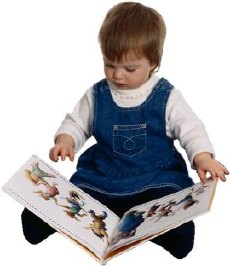
I met Malysia parents and this baby in the twin tower in Kuala Lumpur. At that time, the parents were taking photoes of the baby. A very lovely baby. So I take one too, after having their parents' permission.

Feb 10, 2005

Science websites: Special Topics

Special Topics As the main page claims, it provides "citation analyses and commentary for selected scientific research areas that have experienced notable recent advances or are of special current interest."

Dec 11, 2004

Molecular Self-Assembly

Molecular Self-Assembly
this pages provides top papers, top authors, top institutions, top nations and top journals of self-assembly.

Nanotechnology

Nanotechnology
this pages gives top papers, top authors, top institutins, and top journals of the nanotechnology.

Dec 10, 2004

two more small thoughts

1. Yu tongmao: a man who solely learn from experience and who see college as an absolutely means
2. from the sound and lights show in Malacca. The Malaysia was colonized by the Portuguese, the Dutch, the British, and the Japanese in succession. When they seek the independence, they unite all the ethnic groups in Malaysia, which demonstrates again that unite we win, divided we fall.

some small thoughts during the trip

1. The appetite for new things and curiosity of what is the law under the superficial scene makes me to pursue my science career.
2. A talk with Huong, a Malaysia business man whom I met in Green Hut lodge, reminds me the importance of English. English is a tool to let one be an international guy. He mentioned that there are good scientists in Japan and Germany who know little English. The lack of knowledge of English prevents them from being international.
3. I got lost twice or more times in KL shopping malls, which proves that the key of design shopping mall is to let the guest get lost and spend more time in the mall and hence more likely to buy more things.
4. I use the gesture of Thumb-up very frequently as an end of asking ways or other info in my travel. I learned the gesture from a guy in C1 Eusoff. I think it is a universal gesture for approval, which also turns me from the role of a learner to the role of more or less a judger.
5. Reading local newspaper reminds of the importance of getting a little knowledge of the macroeconomics, while doing the daily purchase make me feel that the microeconomics is also important.
6. I thought about chenyi in my trip. A teacher whose student is greater than her/him is the best teacher.
7. In the morning the 7th Dec, the host of Green Hut Lodge greeted me with “hi, zhe shi wo meng de nanjing ren!” it makes me feel a little proud because I may be the first nanjing ren in Malaysia Hostels
8. I ran, ran and ran, with the last hope of the kind service lady will let me in , and got to the Petronas Twin Tower 15 minutes after the time (4pm) shown on the ticket.
“I know I was late, but...”
“why are u late?”
“I lost my way.”
“do not do this again anywhere.” and she lets me in...
9. Yu tongmao: a man who solely learn from experience and who see college as an absolutely means

small travel tips continued

1. I do not change the money to ringgit before arriving at Malaysia, which makes a little trouble when check in the hostel. Change the money before arriving at the country, or use the mastercard or visa card to draw money.
2. I bought the city map at the night I arrived at Kuala Lumpur, which is after I had found the hostel. Get the city map as early as possible, which make finding the hotel easier.
3. I used the compass throughout my journey. Always equipped with a compass when traveling!!
4. I do not bring an umbrella with me to Malaysia. And luckily, there is no rain in those days. But, next time, get the weather info of the destination and decide whether to bring the umbrella.
5. The Kuala Lumpur is small. All the places of interests are within walking distance. Take a note of the scale of the city map, the KL is 1:12000 and the size of the map is about 2 times the A4 size.
6. I use the single-shoulder bag in the trip, which hurts my shoulders. Next time, use the double-shoulder bag.
7. Muslin food is spicy, very spicy.
8. I bought 4 tins of beer in Malaysia. Every tin costs 7 ringgits. A usual meal will cost less than 5 ringgits. So, beer in Malaysia is much more expensive compare to beer in China.
9. I rent a very bad room in Malacca. The mirror in the room is broken, the bed sheet is not clean, the wall of bathroom which is shared within a floor molded. All of these spoil my mood. Look the room before renting it in the budget hotel.

small general travel tips

1. I forget to bring the shorts with me to Malaysia: check the clothes!
2. The Hostel of Green Hut Lodge does not provide toothbrush, toothpaste, soap, towel, slipper or blanket. Other hostel may be the same.
3. The free tourism map of Malacca is not complete. The express bus station is not in the right location of the map, maybe because it is a new express bus station. So asking the way together with the help of map is the best choice in finding ways in a strange city.
4. When I try to locate myself on the map, it is easier to find the rivers, if any, first if the road name is not easy to find on the map. Use the geographic info such as river, mountains, even the position of the sun to help locate myself.
5. I walked from the Malacca express bus station to the downtown, which is a long way. But the next day I found out that there is a “domestic” bus travel between the express bus station and the downtown. Remember to use the convenient public transportation to save my energy when traveling. There should always be bus shuttle between inter-city transportation stations such as airport, railway station or express bus station and the downtown area, if those stations are not in downtown.
6. Note the way of my generalization of the tips—from specific to general. It is a form of thought that I am not used to.
7. I read the local newspaper Star in Kuala Lumpur and the 东方日报 in Malacca. Two pieces of important info: media watchdog: reporters without borders and www.project-syndicate.org. Critical thinking helps me to get more from reading local news, especially the ability to see behind the surface. Keeps alert when reading newspapers, it is completely different from reading science articles in that nearly all the information is subjective.

Dec 2, 2004

little life quote

"行百里者,半九十. "

the benefit of writing summary or outline of a book

I find that writing summary or outline of what I am reading, especially textbook, will help me grasp the whole subject and understand it better. I have practiced it since the first year of my university life. Writing summary or outline in the process of reading will help me keep a track of what had been stated in the book, preventing me from losing myself in specific details. It reminds from time to time me that which part of the subject I am now going to detail. And it also let me to think about how one part of a subject relates to other parts of the subjects, and hence get a full view of the subjects. So, though writing the summary or outline will slow down reading, it is actually a more profitable. I will keep this habit when reading new subjects and science articles.

Zhu zhaorui

Zhu zhao rui writes in his book, US$3000 I Travel Around the World, his five philosophy of travel. The first is that travel is kind of lifestyle. More and more young people in the aisan countries joined their western contemporaries in travelling around the world. Next is that travel is life investment. The experience in the journey as well as the experience of preparing the jouney will pay you off in the rest of your life. The third is that to travel is to explore not to take a risk. Life is more important, really. Travel is never a kind of self-torture, which comes the forth. And finally, travel differs from tourism that its end is not entertainment. I think the fifth one is now benefiting me. I have decided to travel to Thailand, not to visit those places of interest where usual tourism group will go, instead, a local university.
Besides his travel philosophy, the another crucial idea expressed throughtout the part of his book I read up to now is that the importance of collecting information. He collects information from a variety of sources including dailly notice on the street, newspaper advertisement and internet. And this idea is also influencing me, and I now begin to read newspaper's Classified now.

Nov 26, 2004

small topics that to be enriched

1. the importance of feedback in university administration
2. The advantages of changing subjects from time to time in a day during the exam-review
3. slow in reaction of daily conversation : my advantage or disadvantage
4. the power of analytical thinking: divide things into pieces will make learning easier.

small simple thoughts

I found I am still a creature of emotion, not a creature of only logic during the stay in Singapore.

"yealah."--Typical singlish.

small life gains hehe

冰水降火,no coffee,
早五成,午晚七。
前额痛,不可用,每周动。
back up file very wee.
谦虚,谨慎,戒骄,戒躁。
Update Norton.

Nov 25, 2004

simple thought: a way to make a difference

create a website of my experience in singapore. and it may develep as a writing website or a chemistry website.

small life experience: a swimming girl

I met cool girl in swimming pool today. She swiming without stop from when I began to swim to when I left the pool. Two things I appreciated in her. one is the persistency in the long run of swim with unchanging speed and the other is cool of her dark swimming suit and glass of the same color. I like it.

some quotes for the memory of my finished philosophy module

"Curiously enough, one cannot read a book: one can only reread it. A good reader, a major reader, an active and creative reader is a rereader."--V Nabokov

"This is how philosophers should salute each other: 'take your time!' "--L Wittgenstein

"Ask two philosophers what is philosophy, and get three answers. Definitions tend to be either trivial or controversial."

"Philosophy...unintelligible answers to insoluble problems." H Adams

"There is nothing so ridiculous but some philosophers has said it." Cicero

I like the first one most, for it is the one that I have experienced and am going to pratice.

Nov 20, 2004

Poet Robert Frost

Singapore Travel Agent. Outbound Tours & Travel Agency : singaporetours.com.sg
Two roads diverged in the wood,
and I took the one less traveled by,
and that has made all the difference.

Making a difference is not so difficult according to Robert, all I need is the courage to choose the road "less traveled by".

Nov 12, 2004

the dialectic thinking


Cicero studied his opponent's case with equal effort or even greater effort. Mill was trained by his father to argue both sides of every question.
I have heard the word "Dialectic" since I was in middle school. It was not until recently that I found its importance in writing as well as in daily life. When I write a critique, the dialectic approach is required in considering whether the article contains important counterargument and hence is balanced or not. In daily life, equipping with dialectic thinking appears to be more important. Today, I apply for a visa to US in order to make a trip to visit my aunt and uncle after my exchange semester is over. Though my uncle, aunt and I had fully prepared for it thinking that the material is convincing enough, my application is denial. The reason, from the consular officer, is "my tie to the Singapore is not strong", and he also gives advice that I'd better apply in China. The case itself is not interesting. What matters here is the feeling of confidence before I applied the visa. Making such argument, I studied my case carefully, but not study the opposite—in what situation that I will be denied for a visa. So there should be no reason for me to be so confident before applying.
Studying the opposite not only matters in daily argument; it is also crucial in self- examination. I am the habitual tendency to consider only the positive side of a case, which may contribute to my optimistic character, and which also prevent me from seeing the fault. Back in home university, I received much more praise than criticism. Praise lead to my pride and sometimes arrogance. I need criticism to see the true self. If such criticism is not able to reach me from the out, I will make myself its source.

what can be generalized from experience


In the last post, I conclude that experience, providing concrete example to life criteria, is important to me. The experience not only serves as an opportunity in which I can practise life criteria; they are also the source of new life criteria. I generalize my experience and make conclusion. I conclude from my personal experience that when weather changes, it is easy for me to get cold and it is the time to take some Vitamin C. But because of various reasons, generalization from personal experience can go too far from being true. I once drink the coffee in the Hall Canteen, and it tastes awful. So I generalized that all the coffee are bad, and I will remain drinking tea. You can imagine how soon I will change my mind. So, what can I generalize from the experience? I think the crucial thing is to find essential reasons. The change of weather results in the decrease of my immune system, and so I am easy to get cold. The decrease of my immune system is the essence of that generalization. However, the bad taste of coffee I had tried is not the essential property of all the coffee, though it is for those offered by my Hall Canteen. So find the essence is key of generalization from personal experience.

the ladder of abstraction


"Semanticist S.I. Hayakawa discussed the idea of an abstraction ladder in which language starts on the ground, so to speak, with an object available to our sense of perception, and moves up to concepts abstracted from, derived from, the concrete source-for example, from a specific cow to livestock to farm assets to assets. He stressed that our powers of abstraction are indispensable. 'The ability to climb to higher and higher levels of abstraction is a distinctively human trait without which none of our philosophical or scientific insights would be possible.' But he cautioned against staying at too high a level of abstraction. "
This passage, from Writing Logically Thinking Critically, reminds me of the importance of richness of personal experience. I used to be very confident of how to lead my life, a little overconfident I think, because I once thought that all the necessary knowledge of life are criteria, such as being honest, being brave, being kind to the old and so on. But as I grow up, I find that if I have not my own experience, those criteria alone are empty. For example, take honesty. It is easy to say I will be honesty to everyone, but sometimes other factors may be more important, like the happiness of patience. More recently, I find I may lie to someone simply because I am tired of explaining again and again what my department is in my home university because in NUS, there is no correspondent department. It is through specific experience that I realize that those criteria alone do not provide reasons strong enough for my action. They may be right, but are so abstracted that they prevents me from fully comprehend what they really mean.
By the way, J.S. Mill also warns that "an opinion of on a point of conduct, not supported by reasons, can only count as one person's preference", which means more of less the same thing.

Nov 11, 2004

Nov 8, 2004

when my spirit is low


It is rare for me. I am usually in high spirit which may be due to constant self-appreciation. (Another interesting topic for self-analyzing) But after having today's critical writing tutorial, I feel depressed. I thought I had well prepared for the Critique on the issue of funding a university. But in the class, I was shocked by how narrow my mind is when the teacher mentioned the possible counter-arguments I have never thought about. Not only by narrow-minded, also am I shocked by my lack of skill of handling whole article which requires taking an overall view of the article. I only addressed the fallacies on the sentence level. After filling myself with unhappiness for a while, I met Sharad later this day. He said that this issue of funding a university is under subjects like economics and probably politics, neither of which I am not familiar with. Suddenly, I feel better. I see a way of catching up. I decided to read some stuff on economics and political science before the final exam of critical writing.

criticism and praise

Recently, I am reading Dale Carnegie's book, How to Win Friends and Influence People. In his book, he tries to persuade us not to find fault of others, but to find ways to praise others. On the other hand, another module that I takes, the critical writing, tends to teach me to find fault in others' argument. It will be a long way until I can find a balance between the two.

Nov 6, 2004

critical thinking

1. Do not focus on labeling the fallacies, rather, fucus on pointing out where the faults are.
2. Study the two-sides of the case, and use dialectic approach to dress the difficult situations, especially when dealing with the analogy.
3. For examining the analogy, always think about the emotion expressed by the analogy. And evaluate it whether it is proper to arouse such emotion.
4. Do not dig one pit too deep, that is, not to analyze one fallacy in great detail. Especially in exam, there is a the word limit.

Nov 2, 2004

Science Watch

Science Watch
this website provides "rankings, interviews, and reports on today's most signigicant science", "tracking trends and performance in basic research".
however, the free online version is out-of-date -- one year late.

science websites: Special Topics

Special Topics
as the main page claims, it provides "citation analyses and commentary for selected scientific research areas that have experienced notable recent advances or are of special current interest."

science websites: Science Watch

Science Watch?
It provides similar information as in-cites, but a little professional, and so a little bit out-of-date.

science website:in-cites - The Most-Cited Institutions in Chemistry, 1994-2004

in-cites - The Most-Cited Institutions in Chemistry, 1994-2004: "1584752150"
This is page of in-cites under the category of institutions.
other categories of in-cites are scientists, papers, institutions, journals, countries and also other viariety of analysis and essays.
as the homepage of the websites claimed, "incites provides a behind-the-scenes" look at the scientists, journals, institutions, nations, and papers..."

sience websites: [ISI Highly Cited Researchers Version 1.1]

[ISI Highly Cited Researchers Version 1.1]
China has 13 highly-cited scientist, 10 of whom are in HongKong.

reasons for taking such modules in NUS

Lao shi ling jing men, xiu xing kao ge ren.

The first sentence gives exact explanation of why I take the arts module in Singapore

The second enlighten me on the way of exploring science frontiers.

Oct 31, 2004

the motive for writing this blog

There should be a motive of this blog. And here, I am trying to give one. The purpose of writing this blog is, at first, to practice my writing, and secondly, to record everyday life experience for future self-examination. So it is either for exhibiting all details of my life, nor for displaying hobby, professional information, although they may be part of the blogposts from time to time. The blogposts is a perceivable record of my rising skill of writing. And posts which are like mirrors for self-analyzing, reflecting the thoughts and gains from my everyday life should have a large share in the blog.

Oct 30, 2004

my innate rebellion and being a leader


The innate rebellion was controlled within the realm of reality by my long terms of servicing as a leader, best advice one¡¯s parents could give.

the power of example


The math textbook in English contains so many examples. I once thought that it is too many. But since these examples are concrete, they help me understand the subject from general abstract definition to concrete vivid things and better the understanding of the abstract terms.
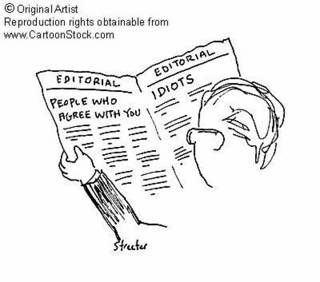
copyright picture from www.cartoonstock.com

Critical thinking


Why is it important to evaluate any information you encounter?
There are also individuals and organizations who, for different reasons, consciously perpetuate lies or partial truths. You simply cannot afford to assume everything you see or hear is accurate and complete.
We should ask questions:

Questioning the information pruducer:
What is the producer's purpose or motive? (Is the information propaganda or an advertisement?)
Is the producer of the information an authority?

Questioning the information itself:
Is the information current?
Is the information complete?
Is there evidence of bias or value-ladened words?

Questioning myself:
Does the information satisfy my needs?
Are there better sources of information elsewhere?

It was not until recently that I discovered how powerful the tool, critical thinking, could be. Its application is not just restricted in evaluation of information as the above paragraph shows. In fact, in daily life when we talk with people, there is a greater need of thinking critically.

Seats


Sitting at the front: listen to speaker more clearly; avoid the disturbance from other audiences.
Sitting in the middle: communicate with other audiences more easily, future profit: making friends more easily.

Qualities of Gentleman


Quality of gentleman
He acts kindly from the impulse of his kind heart.
He respects even the prejudices of men whom he believes are honest.
He opposes without bitterness and yields without admitting defeat.
He is never arrogant, never weak.
He bears himself with dignity, but never haughtily.
Too wise to despise trifles, he is too noble to be mastered by them.
To superiors he is respectful without servility; to equals courteous; to inferiors kind.
He commands with mild authority, and asks favors with grace and assurance.
These are excerpts from the Victorian station. Of the special interest is the second one.

grids and concentric circles


Today two old notions of morality, mentioned by my philosophy teacher, came into my mind when I think about the human love. The notions can be explained as grids and concentric circle of morality. For the first one, it is said that we have some moral principle which guild our actions and we apply it equally to everyone, such as punishing the murder. For the latter, it is said that we owe much more to those near us, so sometimes we tend to tolerant more about them. They sometimes contradict each other in some specific situation. (Actually it is related to my first philosophy paper-when should be ok to play favor to those close to us? May be the one out of only two in my lifetime)
And when I think about desire and impulsion and rationality, I found something similar. If the ration is like the grids and the impulsion is like the concentric circle, I will feel better if I rationalize the degree to which I can extend my desire and impulsion, when I express my feelings and acts accordingly.

Oct 29, 2004

Reading Mill


I spent most of my time this week reading J.S. Mill¡'s On Liberty. I thought it was about political science. But then I found that there is many discussions about human nature in general. Some of them are quite deep. I'd like to quote some of them in this post. What's more, one difficulty for me to understand Mill is his 19th century English. It is was not until last a few days of my reading that I found that reading it with reference with a Chinese translated version will make things easier. I have the similar experience when I read science textbooks by myself. To be more specific, since one textbook only offers one version of presenting the subject, we will get better understanding of one subject by referring to several ways of presenting it. We get different approach to it.
Quotations on Mill's On Liberty:
1. Society can and does execute its own mandates: and if it issues wrong mandates instead of right, or any mandates at all in things with which it ought not to meddle, it practices a social tyranny more formidable than many kinds of political oppression, since, though not usually upheld by such extreme penalties, it leaves fewer means of escape, penetrating much more deeply into the details of life, and enslaving the soul itself.
2. No one, indeed, acknowledges to himself that his standard of judgment is his own liking; but an opinion on a point of conduct, not supported by reasons, can only count as one person's preference; and if the reasons, when given, are a mere appeal to a similar preference felt by other people, it is still only many people's liking instead of one.
3. Another grand determining principle of the rules of conduct, both in act and forbearance which have been enforced by law or opinion, has been the servility of mankind towards the supposed preferences or aversions of their temporal masters, or of their gods. This servility though essentially selfish, is not hypocrisy; it gives rise to perfectly genuine sentiments of abhorrence; it made men burn magicians and heretics.
4. That mankind are not infallible; that their truths, for the most part, are only half-truths; that unity of opinion, unless resulting from the fullest and freest comparison of opposite opinions, is not desirable, and diversity not an evil, but a good, until mankind are much more capable than at present of recognizing all sides of the truth, are principles applicable to men's modes of action, not less than to their opinions.
5. But it is the privilege and proper condition of a human being, arrived at the maturity of his faculties, to use and interpret experience in his own way. It is for him to find out what part of recorded experience is properly applicable to his own circumstances and character.
6. He must use observation to see, reasoning and judgment to foresee, activity to gather materials for decision, discrimination to decide, and when he has decided, firmness and self-control to hold to his deliberate decision.
7. Those who have most natural feeling, are always those whose cultivated feelings may be made the strongest. The same strong susceptibilities which make the personal impulses vivid and powerful, are also the source from whence are generated the most passionate love of virtue, and the sternest self-control. It is through the cultivation of these, that society both does its duty and protects its interests: not by rejecting the stuff of which heroes are made, because it knows not how to make them. A person whose desires and impulses are his own-are the expression of his own nature, as it has been developed and modified by his own culture-is said to have a character. One whose desires and impulses are not his own, has no character, no more than a steam-engine has a character.

Oct 26, 2004

Reading newspaper


Newspapers are supposed to be in neutral position. But they do not only deal with facts, they present opinions. Sometimes the opinion is hidden between the facts which make it difficult to tell what position they take. We do not read all the newspapers after all. Still more difficult is to identify the value of the society or culture behind the newspaper. To achieve this end, one will not only deal with all the stuff in the newspaper, but also know what important thing is not said in the newspaper.
Every morning, I read The Straight Times, a newspaper widely read in Singapore, and I do not feel anything special about the papers until one day a girl who is in a special education program in NUS, told me some hint. She said that what the Straight Times reports will let you feel that the world is full of danger and uncertainty, but our little island is safe, warm. I think about it, she is probably right. I read from the newspaper that how Chinese government are facing difficulty in steering the economy, how Japan suffers from a recent earthquakes and so on. However, I seldom come across an article that questions the current government and challenge their leaders with hard questions. What I heard is all praise for their great leaders, for how they lead them to the current thrive of S¡ngapore. This is interesting topic of political science. And also recently, an optional reading for my philosophy class is on the political lies, how many kinds of political lies and what function does each achieve. It appears interesting, but unfortunately, I have not done my reading yet. This again relates to something still deeper. It is the values of the society. I look for the definition of values on the web, and find the following stuff on wickipedia. Quite interesting. And I will not be able to write about it today.
Personal and cultural values
Each individual has a set of beliefs and ideas about general concepts that are called values. They describe how much value a person places on various ideas, objects, or beliefs. Societies have values that are shared between many of the participants in that culture.
These values can be grouped into four categories:
Ethics (good, bad, moral, immoral, amoral, right, wrong, permissible, impermissible)
Aesthetics (beautiful, ugly, unbalanced, pleasing)
Doctrine (political, ideological, religious or social beliefs and values)
Inborn (inborn values such as reproduction and survival, a controversial issue)

Oct 25, 2004

Analyzing!!


I recently find a way to analyze one self. Perhaps it is to trivial to others, but I consider it as a great discovery to me.
The way is to separate one self to two part, emotional part and the rational part. The emotional part is what I feel. The rational part is what I think. Most of my daily output including talks, writings and actions, are the results of process of one, or both of the two. For example, appreciating arts is basically purely emotional; forming an argument is basically purely rational. These things will not cause many troubles. What I most concerns is the middle part, which involves both sides and the interaction between them.
The perfect example to illustrate how the two function is about love, particularly the love between young guys and girls of my age. While the emotion part functions predominantly at the beginning of the love, deciding who will get shocked and by whom, the rational part will gradually take the fraction from his counterpart until they two reach a balance. I think the balance varies from people to people, and that¡¯s why there is so many kinds of love. For me, the ration part have a larger share.

Oct 23, 2004

slow in reading


My philosophy teacher says we should not read too fast when reading mill, otherwise we will forget what we have read just a couple of minutes ago. but I think I read too slow. And perhaps, because I read too slow, I do not think much when I was reading. And because I do not think much, I alos do not remember what I read just a couple of minutes ago. It is said that we'd better do the rereading. That works well for me.

change in life goal


It seems that I have changed my life-goal. In Nanjing univ where natural science research is her major concern, and where I am filled with all kinds of formulas, being a science professor became my life goal. But when I moved away from home, as an exchange student in NUS, the contents of my life has changed a lot. Here, science stuff counts only a small fraction. In NUS, I read Plato, Descartes, Mill; I listen to concert; I realize the power of critical thinking; I join the talk of Entrepreneurship and I write a lot. Not surprisingly, I tend to believe that one's life-goal is not so simple, just to become somthing or someone. I believe, that my life-goal, rather, is to develop the critical thinking, to read more about whatever possible, to gain understanding of human nature and ethics, to appreciate music and arts, and at the things doing science stuff as long as I like doing it.(Perhaps science will be rice bowl.)

I hope when I come back to my home again, I will be able to keep this mindset, and go on to practice whatever I think is good to me.

Oct 21, 2004

what is wisdom


knowledge v.s. wisdom: in the science of music lecture, when the professor try to explain how numbers are transferred in the cable, he said that "every question is a good question, and I am not saying that all physicists and engineers are smart, and all the arts students are dumb." sometimes, we think we are wiser than others because we have more knowledge, but it is not true. wisedom is something beyond knowledge.

Motivated irrationality


motivated irraionality: the late night Grace want the early morning Grace to get up in the early morning, and she knew that if she put the alarm clock too near her, she will stop the clock and go back to sleep. So, even the late night Grace know that the early morning Grace is going to curse her when getting off the bed, walking across the room to turn down the alarm to be more wake-up, the late night Grace is still going to put the alarm in the opposite end of the room.
or buy one big clock loud enough to wake up the dead.

Oct 18, 2004

the loss of passion


The loss of passion. It seems to me that for all the thing I am going to do, I will at first reason whether it is a good thing to do or not. This is good to me in most cases. However, I therefore, loss the passion of life. It is seems that I should send gifts to my friend, then I send, that I should send a necklace to my girl, then I send. or perhaps, I have not meet the one who can give my real passion yet? perhaps.

Oct 16, 2004

the Peril of Arrogance


Arrogant person seems to overestimate his/her capacity. I am not an arrogant person, but sometimes over-confident. When I judge other's capacity, I have the tendency, if possible, to compare his/hers to mine. And often, when I thought he/she and I were equally capable of doing certain things, it often turns out that he/she can do better than I do.

Ambition


I have just had a talk with a thoughtful and knowledgable girl. She is in a special sholarship program and takes the toughest modules in NUS. She stired up the inner ambition of mine and wake me up from worries about troublesome daily trivials.
copyright picture from http://www.cartoonstock.com/

Oct 15, 2004

imperfect beings and its language, logic


I am working a propability project about the Bertrand's paradox. while those famous mathematicians think it that there may be a hole in the pinciple of indifference. I think this paradox may just be caused purely by imperfection of the human languange and logic. Some E.T.s may do not have such paradoxes at all, perhaps they are now observing us in some remote area in the universe and wondering how these so-called intellectual beings on the planet E!#$h do not try to find flaws in their mind but to work on how to justify the product of their thoughts.

trying of new software: hello


This is my bike during the cyclohunt. Posted by Hello

good website: www.cartoonbank.com Posted by Hello

on dating

Date--An appointment, especially an engagement to go out socially with a member of the opposite sex.

Are the two person on a date necessarily lovers?

I think I have never dated any girls out successfully. But, I have often gone out “socially with a member of the opposite sex”. Anyway, this is not the point here.

I bought a book called dating—clues for the clueless. The book is quite interesting and well-written. Absolutely for guys like me who never actually date out anyone. I once see dating as a weird thing that eats up time unconsciously quickly. I would consider myself to be crazy if I buy such books in China

Still I do not make much progress on it after I arrived in Singapore, where almost everyone around is dating. I could remain stubbornly unmoved even a commonly-sensed attractive girl is aside. I may be too selfish of my time. Even chatting for a long time, I would blame myself. In this sense, I am a workaholic and not a social guy.

I like the words from Higgins in the movie My Fair Lady, "enjoying the philosophical peace of myself". But on the other hand, I do not like to be a confirmed old bachelor as he.

Just a piece of free-thought outside work

"Nothing is obvious."--a post by my philosophy tutor

"Nothing is obvious", I often say in class. Let me explain a little, while I'm stuck in bed with antibiotics and my old Faye Wong records.

Red lights flash, sirens flare, but mostly my eyes glint when someone says that a philosopher is "obviously" wrong. It's a good sign that, hidden from view, there lies a larger battle between their philosophical aims and assumptions. That's why I urge caution when you read an old text. If Meno's paradox of inquiry looks obviously silly to you, don't assume that Plato (or Socrates) is a fool. He must have good reasons for accepting the paradox and talking about past lives. Look elsewhere. Does Plato share our assumptions about knowledge? Is he using these concepts in the same way? Is he solving a different problem? If Descartes' argument from fallible senses seems obviously self-defeating, why doesn't he think so? Look again.

Last night, I came across the same message in an essay by the American philosopher John Rawls:

"I always took it for granted that the writers we were studying were much smarter than I was. if they were not, why was I wasting my time and the students' time by studying them? If I saw a mistake in their arguments, I supposed those writers saw it too and must have dealt with it. But where? I looked for their way out, not mine. Sometimes their way out was historical: in their day the questions need not be raised, or wouldn't arise and so couldn't then be fruitfully discussed. Or there was a part of the text I had overlooked, or had not read. I assumed there were never plain mistakes, not ones that mattered anyway." (with my italics)

Autobiography--the same book I'd recommended extracts from

This problem of obviousness takes an odd twist with Descartes' Meditations. We often find his arguments, rather than his errors, too obvious. "Oh, it's just the Matrix."; We agree too quickly with Descartes' conclusions (even when we don't take them seriously). Or, if we disagree with them, we accept too readily his procedures. We rehearse them carelessly, much like National Day songs we don't quite believe in.

Meditations, that "the least bit of doubt on any point will suffice for complete rejection". What counts here as a legitimate doubt? I emphasized during tutorial the 17th Century obsession with "method". They had nothing like our modern view of science with its official hypothetico-deductive slogans. They were struggling to fit new scientific practices into old Aristotelian models of knowledge. What is science? What is a proof? How do we judge evidence? What is justification?--These were open questions for Descartes and his audience. Nothing should be taken for granted; he is not pointing to any clear-cut sceptical procedure which we can apply, unthinkingly, to our beliefs

Descartes proposes a new model of knowledge based on his standard of absolute certainty. What counts as "absolute"? Does it even make sense to think of an absolute level of certainty? He tried to show us in the rest of the Meditations, drawing on a contrast with the standards of reasonableness and probability. The tricky bit: in the "First Meditation", that new model and its standard are insinuated into the four stages of doubt. The epistemic standard assumed in the Fallible Senses and Dreaming Arguments is the very one they persuade us to adopt. They wouldn't make sense without the very standard they justify. The arguments seem, in a sense, circular; but are they any worse for it? What might this say about Descartes' project? If his arguments work, that is also because we accept (at the same time) the possibility or coherence of that absolute standard. Must we?

Here is a related worry about the "First Meditation". In the painting analogy, Descartes suggests that there are "still simpler and more universal things" which cannot be cast into doubt by dreams. He goes on, quite blithely, to list several metaphysical and mathematical concepts. But are these obvious choices? The Aristotelians, for instance, would deny that "corporeal nature in general", time, place and number are somehow more basic than the things we ordinarily see and touch. How do we decide that they are "the simplest and most general things"? Can we not dream that 2 + 3 = 6? Or that a square has five sides? Why not? What is Descartes up to? What madness is he courting?

Oct 14, 2004

verb, verb, verb

This is post uploaded by email.

The toughest part of English language, as far as I have found, is verbs. Mostly often, choosing the proper verb takes up most of the time I spend in wording.

I think those whose mother language is in English also have such difficulty. So they have the tendency to use short phrases instead of long verbs to express themselves in the daily life. Like want I have just use: "take up"; in stead of "occupy".

Maybe it is a common phenomenon in all the civilization, because our space for memorizing things in brain is limited.

Anyway, perhaps.

Yeah! I have made myself clear!

This a e-mail updated post.

During the group discussion in critical writing class, the most frequent sentence I said is that "yeah! I've made myself clear finally!"

I often find that it is difficult to make my idea clear to those Singaporeans. I spent quite a lot of time on thinking how to present my idea in a clear and precise manner, like drawing a diagram to show the logic connection between the points I made. It is of less frequent for my Chinese classmates to have this understanding difficulty.

Thinking about it twice, I guess that, though part of reason is the culture gap, part of the reason is that I am lack skill of communication. If I have the better skill of communication, my idea in mind will be easier to carry to the others.

Oct 9, 2004

the US presidential debate

This post uploaded by E-mail.

This is my first time to hear so much about the presidential debate of US. I browse the New York Times website on the related issues. I am surprised to find there are so many issues these two men disagree about. I do not know who take his position first, but it seems that on every debatable issue, if one takes a position, the other would take the opposite. It gives me the impression that they do not bother to choose which position to take, but they do bother in explaining to the pubic why they choose the position. It is like that one toss a coin and the head turn out, and then makes his whole effort to explain why the head turns out not tail. It is quite incredible for me that how the American benefit from this kind of election.

Oct 8, 2004

simplicity v.s. the richness of the personal character

I attended a class called science of music. The teacher requires all the students to compose one piece of music in midi form in November, the end of the semester. I am now trying the software he provided to listen and write several notes. I am happily surprised to find out there are so many instruments for me to choose, but sadly at my weakness of describing what emotion the music is carrying, in other words, though I can feel the difference between pieces of music, I couldn't tell in words what exactly I am feeling.

I am trying to figure out why it happens on me. The first reason, I can think of, is that I am not good at expressing feeling even in daily life, nor have I seen the need in my previous life to express my feelings. My previous life do not comprise variety of emotions, simply because it is too simple, to be more specific, from school to home, and then to school. And the role I am playing in my life is son, student, and then student, son again, oh, perhaps often friends and classmates. That is all. So the second reason for my lack of rich emotion is that my life is simple and there is no complicated feeling for me to express.

However, since I see farewell to my parents and the city I was born and went on a journey to explore the world on my own, I began to see the need not only to advance my knowledge, but to explore my realm of emotion also.

The first thing for me to do is to distinguish the different emotions in words, perhaps the music will serve as a good guide.

Oct 7, 2004

logic v.s. knowledge

I had always believed that logic is the uttermost important thing in the world. as for knowledge about the nature around me, what I need is just only a few pricinples so that I could build up the whole masion of my knowledge by logic and let it guide my action. I still have some of the principle in my mind: treasuring life, be breave, be modest, keep my word.
it is not until recently that I found a big problem in my doctrines: there are too many of them!! too many to remember and what's more, some are even contradicting with each other. for example, be prudent v.s. be brave, when carrying out a new business plan or try something new, these two are always contradicting. Yes, one may say that one can find the balance in between, but how? need another principle, called the principle of the between and adding it to the divine pantheon which left no place for one more? moreover, even if one thinks one find the balance, how can he know there is no other better way to do? so here, principle do not work at all, the same pity for the pure logic who loses his ground!

weep for my logic!
to be continued

Oct 5, 2004

should I talk so much?

I went to a talk about the student exchange program between universities. In the talk, I say something about my friend's girlfriend's wishes of visiting china and got a parttime job there during the winter vacation. and also some other cases with this, in order to show that there is a potential of exchanging students between my current universities and universities in China.

but after the talk, I think I may just talked too much about my personal privacy or actually others. on the other hand, I should be specific to be convincing.

what a dilemma!

we are always supposed to fall into such difficult situation, you cannot go up, either can you go down! so sometimes, the best way is to remain silence when you do not really know what to say!!